
When the Curriculum We Need No Longer Fits into Today's School Time
Schools today receive new expectations all the time. It falls to school leadership to keep the curriculum from becoming a collection of demands and to create the conditions for the school community to decide, with clear criteria, which learning matters, at what depth and in what progression.

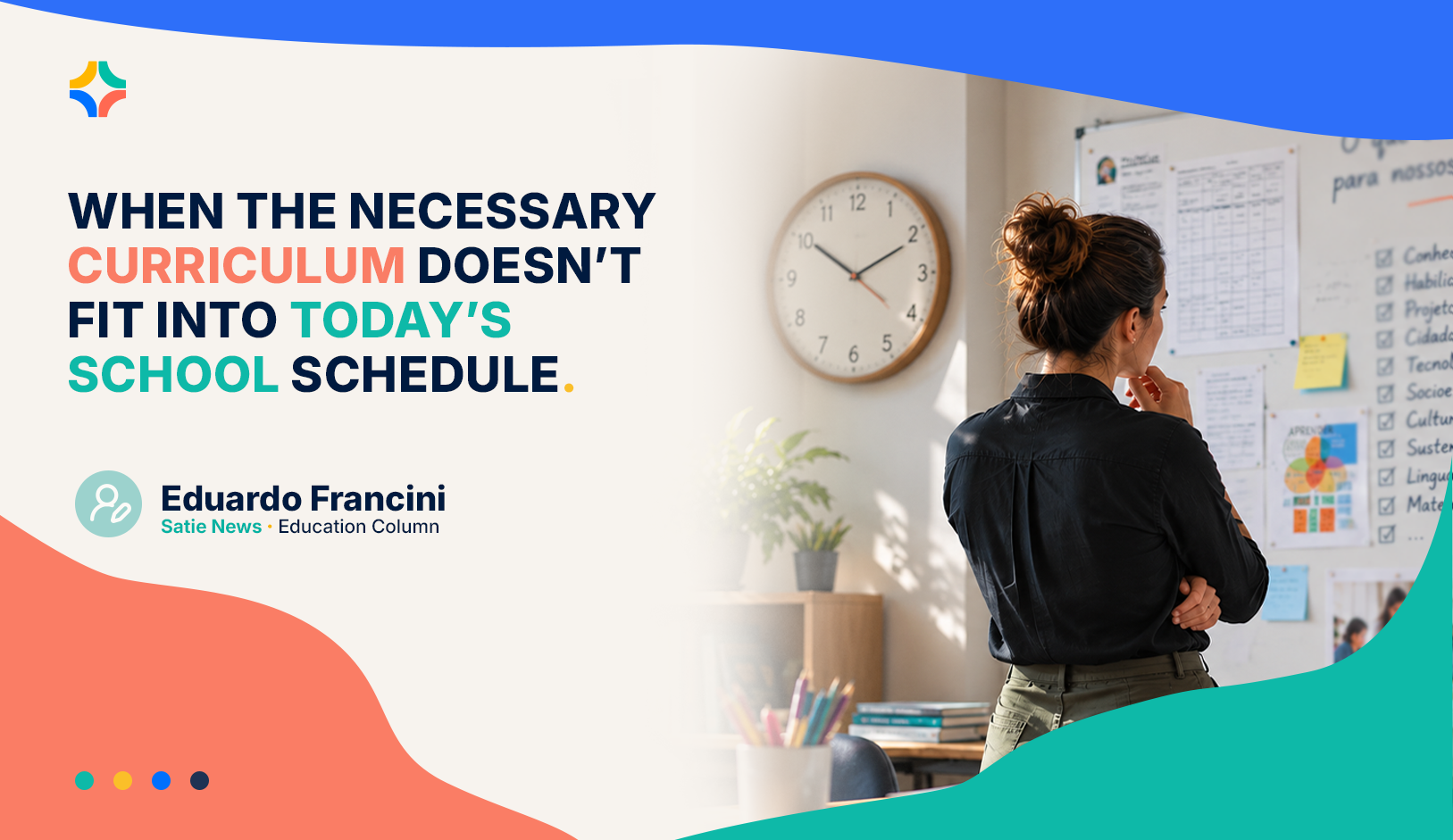
One school decides to bring financial education into the curriculum. Another realises it needs to discuss artificial intelligence and authorship. Demands emerge around mental health, sustainability, digital citizenship, ethnic-racial relations, inclusion, entrepreneurship, life projects and the transformations of the world of work. At the same time, the knowledge historically associated with the different fields and subjects remains in place.
Taken one by one, almost all of these demands can be defended. The problem appears when we try to fit them into the same calendar, the same working hours and a school organisation whose time does not grow at the same pace as the expectations placed on education.
When the curriculum we need no longer fits into today's school time, what should we protect: the number of topics presented to students, or the quality of the learning they are able to build? Before answering that, let us try to answer a prior question: a “necessary curriculum” for whom?
In the first piece in this column, I proposed understanding the school as a learning community, one in which professionals also need time and conditions to learn. If the whole school community experiences the effects of these expectations and takes part, in different ways, in educating students, the discussion about the curriculum we need has to involve teachers, other staff, students and families. That participation does not remove the specific responsibilities of the pedagogical team, whose task is to bring the different perspectives together and turn listening into curricularly coherent decisions. A school that learns also has to learn how to choose collectively.
A curriculum rarely becomes excessive because of a single decision. It grows by addition. A new subject is created, a project is incorporated, a platform introduces another sequence of activities, an international programme adds objectives, an assessment requires certain content, and a legitimate social demand needs to find some form of expression. Since almost nothing is removed or reorganised, every new item starts competing for space with everything already planned.
This becomes especially visible in private schools. Beyond the knowledge defined by the national common curricular base and by local curricula, many institutions develop their own projects, bilingual or international programmes, social-emotional proposals, career guidance initiatives, exam preparation, digital education and experiences shaped by families' expectations. This diversity can significantly broaden students' education. It can also produce fragmentation, overlap and haste when the relationships between these proposals are not examined closely enough.
The problem is not the existence of a broad curriculum. An education that intends to help children and young people understand a complex world cannot offer only a minimal, utilitarian formation restricted to what is most easily measured.
In the report Curriculum Overload: A Way Forward, the OECD identifies different expressions of curriculum overload. It may come from the sheer amount of content, from teachers' and students' perception that there is not enough time, and from the imbalance between certain areas and educational purposes. The document also draws attention to the risk of curricula that cover many topics with little depth.
That risk is not solved by speeding up teaching. The harder a school tries to “get through” everything, the greater the pressure to cut questions short, reduce experiences, anticipate answers and move on before students have had time to connect ideas, make mistakes, receive feedback and return to what they have not yet understood.
Content may have been presented, recorded in the teaching materials and ticked off in the plan. That does not mean it has become learning.
Curriculum time is not merely a division of the timetable. It is also the time needed for an idea to be understood, compared with others, used in different situations and incorporated into a student's repertoire. Some learning requires continuity over years. Other learning needs to be revisited at different points in development. And some cannot be planned as a linear sequence at all, because it depends on shared life, experience, inquiry and the possibility of formulating new questions.
Prioritising, then, should not mean simply drawing up a shorter list of content. Before deciding what stays and what goes, it is necessary to discuss what students are expected to do with what they learn. Recognising a piece of information, understanding a concept, using a procedure, sustaining an argument and making a decision in an unfamiliar situation are distinct expectations — and they require different amounts of time.
In Os impactos da Base Nacional Comum Curricular na construção do currículo piracicabano, an article I wrote with Maria Alejandra Moreno-Pizani, we analysed the relationship between a national curriculum policy and its construction in the local context. One of the issues raised by that work is precisely the need for the curriculum to be built collectively and intentionally, reaching political-pedagogical projects and teachers' planning.
A curriculum framework may define learning considered essential, but it does not remove the need for interpretation. Between the official document and students' experience there are decisions about organisation, sequence, depth, strategies, relationships between areas of knowledge and adjustment to context. An enacted curriculum is not a list that simply moves from the document into the classroom.
In my research on teachers' perceptions of English language teaching in the national curriculum base, this space of interpretation also proved significant. Teachers do not merely implement a curriculum policy: they attribute meaning to it based on their knowledge, working conditions, conceptions of language and professional experience. It is in that mediation that the prescribed curriculum comes closer to — or drifts away from — what students actually encounter.
Recognising this mediation does not mean transferring the whole responsibility for curricular selection to teachers. If every teacher has to resolve the conflict between breadth and depth alone, the institution risks producing fragmented pathways, unnecessary repetition and gaps that will only be noticed later.
Curricular choices need to be taken on as institutional choices. This involves teachers, coordinators and school leaders, but it also requires listening to students and talking with families. Not every expectation can be incorporated in the same way, and that limitation needs to be made explicit.
Part of leadership's work consists of formulating questions that come before the inclusion of a new proposal: what educational problem do we intend to address? Is this learning already present in another component or project? Does it need to become a subject, can it be integrated into what already exists, or should it cut across different areas? What will lose time if we add it? How will we know whether students have learned? And for how long will the proposal be monitored before we conclude that it worked?
One possible path is to start from the curriculum that was actually carried out over the school year. The team can compare what was planned with what genuinely had enough time, identify learning that had to be revisited, locate repetition across years and components, and recognise proposals that stayed on the calendar without producing the expected results. Students' work, assessment records, teachers' observations and listening to the community help to make this analysis less dependent on isolated impressions.
From that mapping, school leaders and coordinators can define a few institutional priorities and monitor their consequences over the school year. This calls for a simple, if not always comfortable, rule: every curricular addition must trigger a conversation about integration, reorganisation or removal. Otherwise, the school will keep adding expectations without discussing the time needed to fulfil them.
It falls to school leadership to protect the process, guarantee time for collective work and sustain the choices before families and governing bodies. To coordinators, to articulate those choices in terms of progression, planning and monitoring. To teachers, to offer the evidence produced in practice. Students, families and other staff help make visible needs and effects that formal planning may not capture.
These actions shift the conversation from novelty to coherence. They also make it possible to distinguish integration from mere juxtaposition. A school may state that a given theme is cross-curricular and still not define who is responsible for it, at what moments it will be developed or how its progression will be monitored. In that case, the theme appears in many places but may not take root in any of them.
Without a shared view of what expands at each stage, some subjects reappear every year in almost the same form, while more complex knowledge is compressed into short periods. The impression is one of constant movement, but students do not always perceive that they are advancing.
It is also worth being wary of the word “essential”. In certain discourses, prioritising the essential becomes a way of reducing the curriculum to what appears in assessments, to what produces immediately demonstrable results, or to what seems to have direct economic application.
A broader conception of education has to protect knowledge and experiences whose value is not measured by immediate usefulness alone. Literature, the arts, philosophy, history, the sciences, movement, languages, shared life and inquiry help students produce meaning, imagine possibilities and understand different perspectives. Prioritising is not impoverishing the curriculum. It is creating the conditions for what the school considers important not to be treated superficially.
This requires institutional courage, because every curricular choice involves giving something up. By setting aside more time for reading, scientific inquiry, writing or the development of a project, the school reduces the time available for other activities. Hiding that fact behind plans that promise to cover everything does not eliminate the trade-off: it only makes it happen in an improvised way, usually inside the classroom.
The pressure then falls on the teacher, who has to decide what to shorten, what to postpone, what to touch on only in passing and what will not be done at all. The official curriculum appears to remain intact, but the enacted curriculum is negotiated daily, often with no collective space to examine those decisions.
A learning community can face this question differently. Instead of treating every difficulty in implementation as an individual failure, it can observe what happens in practice: where students need more time, which concepts support later learning, where repetition occurs, which projects genuinely integrate knowledge, and which activities remain on the calendar only because they have always been there.
This process does not have to end in a smaller curriculum. It may result in a more articulated one, in which certain learning stops competing and starts reinforcing itself. It may also reveal that some themes require a stronger presence, while others can be addressed in a more concentrated way or at different stages.
For a private school, communicating these choices is part of curricular work itself. Families may read the number of subjects, projects and materials as a sign of quality. It falls to the institution to make it understandable that learning in depth also requires limits, continuity and time. A well-grounded pedagogical choice does not offer less education: it protects the conditions for the promised education to actually happen.
This may be one of the main challenges of curriculum management in today's school. It is not about finding a formula capable of accommodating every expectation, but about building criteria to decide which of them should guide the pedagogical project, how they relate to one another and how much time they deserve.
When everything is a priority, priorities stop guiding the work. The curriculum we need is not an inventory of everything that seems important to teach. It is a collective, intentional and revisable construction, able to offer students breadth without giving up depth.
Schools will always make choices about the curriculum, even when they do not state them. The decision for school leadership is whether those choices will continue to be made out of urgency, fragmentation and each teacher's solitary effort, or whether they will be taken on as a central part of institutional learning.
Discover Satie
Satie is a data intelligence layer for education that connects information from the different systems a school already uses, helping leaders turn scattered data into a more integrated view for decision-making.
Want to understand how that connection could work in your school? Discover Satie.
Discover Satie


